Skilled Professionals Are Key
I am frequently approached by companies asking if I can refer someone with a strong technical background
, says Christian Blatt. The demand for skilled professionals is everywhere, whether in sustainable building technology, control engineering, power systems, or microprocessor technology. Fortunately, TH Lübeck offers a range of degree programs that prepare people for the challenges of the energy transition, and we always welcome applications
, says Jochen Abke, Vice President for Studies and Digitalization at TH Lübeck. Prospective students need not fear mathematics. In conversations, we often hear concerns that one’s math skills might not be sufficient for university. We offer preparatory courses to prepare all students for their studies. Our instructors are also happy to provide personal advice and hands-on support during the program.

Around 5,000 future professionals and leaders are currently studying at TH Lübeck, including many who will help shape the energy transformation.
A simple LED bulb today consumes only about a tenth of the energy a traditional incandescent bulb once required. This advancement in energy technology wasn’t immediately embraced by everyone. What helped the industry and ultimately led to the breakthrough of LED technology was a clear political framework
, says Dr. Norbert Reintjes, Professor of Industrial Ecology in the Department of Applied Natural Sciences at TH Lübeck. Prior to his academic career, he led environmental product innovation at a consultancy, contributing to the development of environmental labels, the EU’s Ecodesign Directive, and the Energy Labeling Regulation.
Household lighting is just one example of how, since the 2000s, regulatory tools in EU product policy have played a critical role in improving the energy efficiency of products used in households, buildings, and industry. In light of the massive climate crisis, however, a rapid and complete transition to renewable energy sources is essential
, Reintjes emphasizes. Legal regulations and incentive systems are integral to this consistency approach, as they establish the conditions that significantly influence the pace of implementation.
Far more challenging for political, economic, and societal systems is the third approach: sufficiency. Sufficiency is often associated with painful deprivation or technological regression, but at it’s core it simply means ‚enough or adequate‘
, explains Reintjes. Reduced consumption can, in fact, be positively perceived and contribute to a higher quality of life.
In the broader picture, efficiency and sufficiency reduce overall energy demand, which then must be met by renewable energy sources. The developments of recent decades show that while efforts to enhance efficiency and transition to renewables are essential, sufficiency plays a central role in tackling the climate crisis
, Reintjes concludes.
TH Lübeck: Practical Solutions for
Climate-Neutral Energy Supply
Our society will continue to consume electricity, which is why faculty and students at TH Lübeck are exploring smart ways to generate it. Whether through lightweight solutions for maritime applications, solar algae, or thermoelectric generators, innovative approaches are at the forefront. The energy produced must then be distributed intelligently and efficiently. Researchers at TH Lübeck are working on that as well, developing technical systems to optimize grid utilization,whether at the level of large-scale grid planning or improving decentralized networks, such as those for EV charging parks.
We also focus on improving the thermal energy efficiency of buildings. This involves taking measurements, running simulations, and analyzing materials and their production under different conditions. Most importantly, we are training the skilled professionals who will lead the energy transition in every sector. It’s no exaggeration to say that TH Lübeck excels at optimizing both efficiency and consistency.
What we can’t solve with technology alone is sufficiency—learning to live with enough. That responsibility lies with all of us as a society.
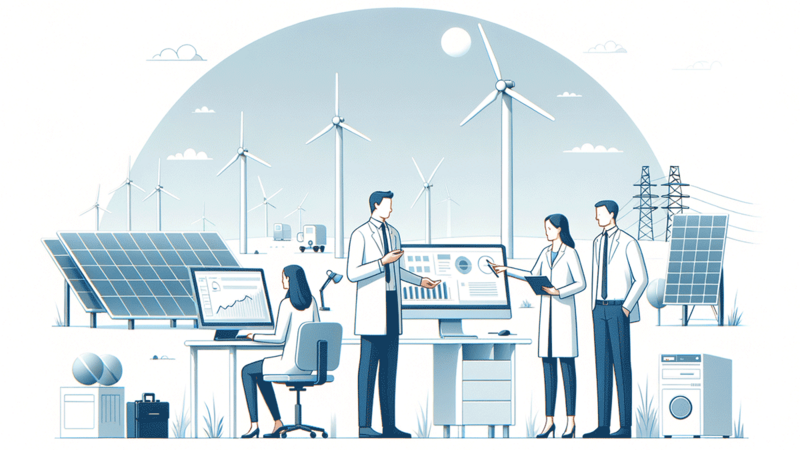
At TH Lübeck, applied research and education are advancing the energy transition.