
BiT SEA-SH
Big Data Trusted Science AI Plattform Schleswig-Holstein
BiT SEA is an open and scalable AI platform for Schleswig-Holstein, developed by partners from academia and industry. The project creates the technical foundations for data-sovereign applications and promotes the transfer of knowledge between research, public administration, and businesses.
| Duration: | 01.04.2025 - 31.03.2027 |
| Management: | Prof. Dr.-Ing. Horst Hellbrück |
| Staff: | Finja Wegener, M.Sc., Tom Kruse M.Sc. |
Background
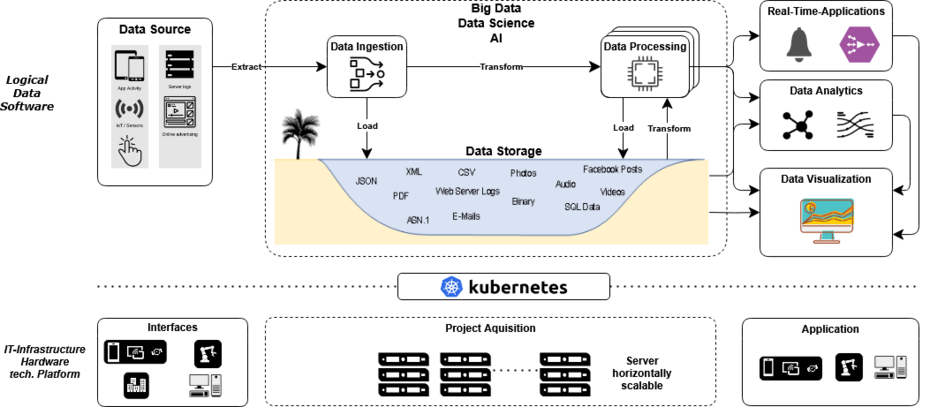
In today's digital world, the amount of data is growing rapidly. Much of this data is too extensive or complex to be processed by traditional database systems. Big data architectures provide the necessary foundation: they enable the collection, analysis and use of large and complex data sets, especially in areas such as artificial intelligence and data science.
A key requirement for such architectures is a horizontally scalable IT infrastructure. This must provide sufficient computing power, storage and reliable file systems to remain efficient as data volumes grow. Standard servers organised in clusters provide reliability and redundancy. If a server fails, it is automatically replaced without any downtime or negative impact on operations.
Objective and Approach
The aim of the project BiT SEA-SH is to create a horizontally highly scalable, highly available and trustworthy AI platform for data and AI-supported data science applications for universities and state authorities in Schleswig-Holstein. In line with the open source strategy of the state of Schleswig-Holstein, the platform guarantees a high level of data sovereignty and avoids digital dependencies. The technical solution is based on modern, orchestratable container solutions, which are already successfully used in research and teaching at the contributing universities.
Innovation
Companies, especially small and medium-sized companies in Schleswig-Holstein, benefit from an open platform that allows them to integrate their own sensor data and AI applications. The interoperability of the platform allows for easy expansion and long-term use beyond the duration of the project. This creates a sustainable basis for the use of AI and big data, which can also serve as a blueprint for companies.
The platform is linked to the AI Transfer Hub Schleswig-Holstein, which promotes the exchange of knowledge and cooperation between research, industry and public institutions. This provides a direct link to current developments in the field of artificial intelligence and helps companies to benefit from the latest innovations.
Technical Concept
The technical foundation of the BiT SEA-SH platform is currently being established as a container-based infrastructure, with Kubernetes serving as the central orchestration system. Kubernetes handles the deployment, management, and scaling of individual platform services within a cluster environment. The distributed execution of applications creates a flexible and resilient development environment in which individual components can be integrated, tested, and further developed independently of one another.
The Kubernetes cluster is currently operated on virtualized resources, allowing computing capacities to be provisioned flexibly and expanded as needed. The separation between the virtualization layer and the containerized applications enables a portable and adaptable operating environment.
A key focus during the current reporting period has been the development of the platform’s storage and processing layer. For this purpose, a distributed storage infrastructure has been established, enabling the persistent storage of structured and unstructured data. This forms the basis for the future processing of large data volumes as well as the long-term storage of analysis results and application-specific data.
In parallel, initial compute components for distributed data processing have been integrated. These already allow the execution of data-intensive analysis and processing tasks within the cluster environment. In addition, initial components for data ingestion are being prepared, which will enable data from various sources to be integrated into the platform in the future. The full integration of additional processing steps, central access mechanisms, and further platform services is currently underway.
The infrastructure that has been established thus provides the technical foundation for the gradual expansion of the platform in the subsequent project phases.
Potential Usecases
Image-based analysis for food quality control
Background
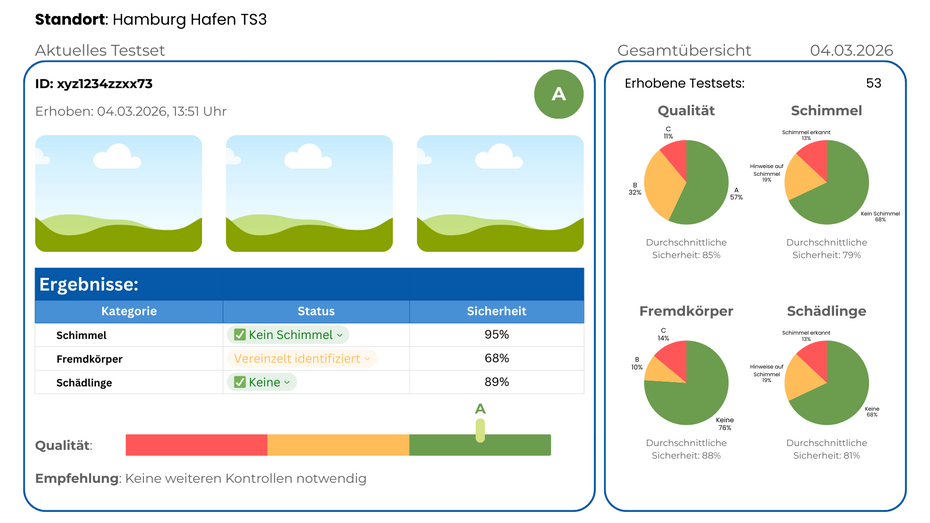
The transportation of food products such as rice and coffee often involves long distances and can take several weeks. During transit, various factors can affect product quality, including moisture that may lead to mold growth, extreme temperatures that reduce shelf life, and pest infestations that threaten food safety. Quality control for foods such as rice or coffee is essential to ensure food safety and to verify that the products are free from contamination, pests, and other defects. A key aspect is visual inspection, where, for example, rice grains are examined for color, shape, and size to detect impurities. However, visual quality control is labor-intensive, as it requires detailed and time-consuming examination of a large number of samples to obtain representative results for an entire batch.
How can BiT SEA-SH help?
The BiT SEA-SH platform can support food quality control by automating image analysis, making the process more efficient and less error-prone. By leveraging advanced AI technologies, high-resolution images of food samples can be analyzed automatically to identify quality characteristics such as color, shape, size, and the presence of foreign objects or pests. The platform enables the processing of large volumes of image data and presents the results in easy-to-understand dashboards and reports, increasing transparency and traceability of inspection outcomes.
AI-Based Analysis of High-Frequency Sensor Data for Early Detection of Changes in Groundwater Systems
Background
International research and monitoring projects in hydrology focus on the long-term protection of the availability and quality of groundwater resources. Coastal regions are among the most sensitive areas worldwide, as their aquifers are exposed to a wide range of natural and human-induced influences. A key challenge is to detect changes in these systems at an early stage, identify their causes, and assess potential risks over the long term.
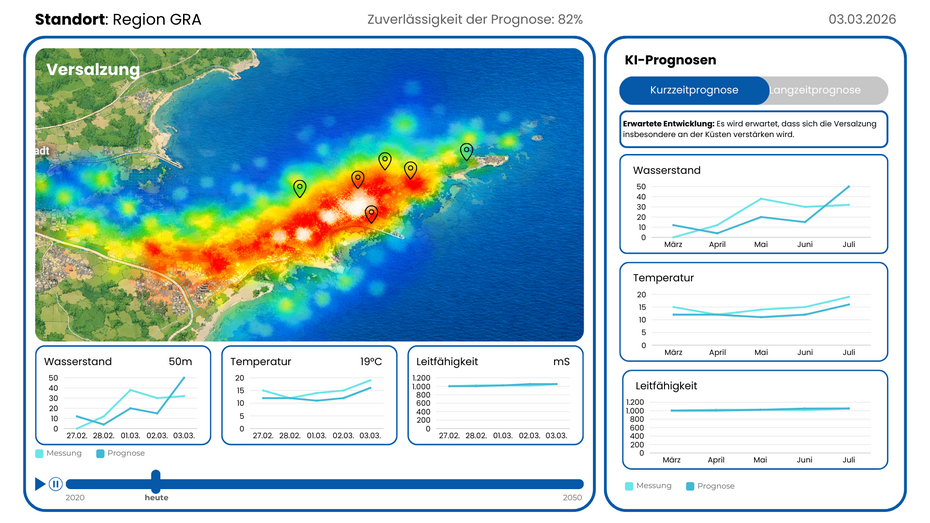
The aim of such research projects is to develop new methods for identifying relevant influencing factors, classifying different change patterns, and providing integrated modelling tools that can represent dynamics and risks in complex hydrological systems. To this end, multisensor systems are deployed at distributed measurement sites to continuously capture various physical and chemical parameters such as water level, temperature, pH value, and electrical conductivity. The resulting high-frequency sensor data are aggregated spatially and temporally to generate time-resolved state maps of the measured values. Using AI-based analyses, spatial and temporal patterns can then be identified. The AI models developed serve both long-term forecasting and short-term nowcasting, especially in regions with limited sensor coverage.
How can BiT SEA help?
BiT SEA can support such research and monitoring projects by centrally collecting, storing, and processing large volumes of sensor data. On this basis, AI models can be trained directly on the platform without research teams having to provide their own physical infrastructure. After training, newly arriving sensor data can be continuously analyzed within the platform. The analysis results can either be exported or visualized directly via integrated dashboards.
The entire processing workflow can be viewed, monitored, and traced by distributed project teams regardless of location. Data, models, and analysis results are available centrally, reducing time-consuming manual data transfers between different institutions and greatly simplifying international collaboration.
If you want, I can also adapt this into a more formal project-description style or make it shorter for a slide.
Road Quality Control
Background
The quality of road infrastructure is crucial for traffic safety, efficiency, and cost-effectiveness. Defective or poorly maintained roads can lead to serious accidents, disrupt traffic flow, and cause significant costs through repairs and maintenance. Traditional methods of road quality control include manual inspections and visual assessments, which are time-consuming and often prone to error. These methods require specialized personnel and are not always able to identify potential problems at an early stage.
How can BiT SEA help?
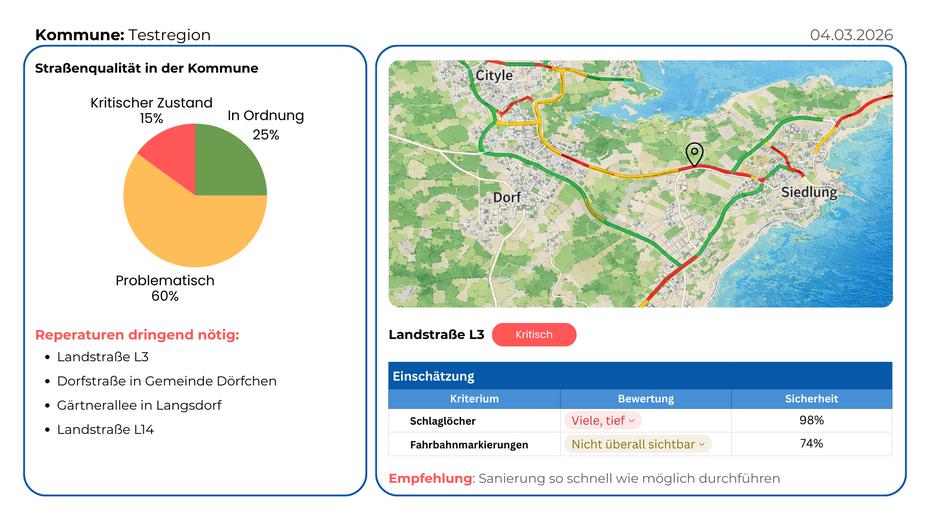
A promising approach to addressing these challenges would be the use of the BiT SEA-SH platform as an integrated, data-driven solution for continuous road quality monitoring. One possible setup would combine vehicle-based sensors with AI-based image analysis: high-resolution cameras and accelerometers mounted on vehicles in municipal or operational fleets could continuously capture image and vibration data from the road surface during regular operation. This data would be transmitted to the platform and automatically evaluated there by AI algorithms. The AI models could detect characteristic damage patterns, classify them georeferenced by severity, and document them with timestamps. For safety-critical findings, automatic notifications to responsible authorities would be conceivable, enabling critical damage to be addressed promptly.
Project Partner

Förderkennzeichen: 220 25 004