
Renewable Energy:
How we help shape the energy transition


Where does the energy come from?
Electricity comes from the socket - but where does it come from? How does it get there? And where does it go when the lights are off?
Nothing works without energy. Energy is the ability to do work, produce heat, or emit light. It powers lamps to illuminate, a heating system to warm, and a car to move.
For a long time, we generated energy by burning materials. Centralized energy providers burn high-energy resources like coal, natural gas, or oil. The energy released is used to power turbines, which in turn produce electricity. Heating systems were, and still are, largely decentralized—for instance, through gas-powered heating systems. Energy production occurred either continuously or on demand: no need for light, no electricity, no power generation. No demand for heat, no heat generation. Electricity is essentially a method of transporting energy.
Why renewable energy matters
We face several critical issues. As with any form of combustion, burning fossil fuels releases CO₂, which accumulates in the atmosphere and accelerates climate change. Fossil fuels are expensive, and supplies will run out at some point. Additionally, reliance on fossil fuels often leads to dependence on the countries where these resources are extracted. A significant portion of the energy generated from these costly fuels is lost as thermal energy (heat). In many cases, this waste heat is simply released into nearby rivers, causing thermal pollution, instead of being repurposed, for example, for district heating systems.
What challenges need to be solved?
Water, wind, and solar energy are also viable sources of energy production. They have a major advantage: they regenerate continuously without requiring combustion or emitting CO₂. Solar energy converts electromagnetic waves into electricity or heat, while wind and water turbines transform kinetic energy into electricity.
Energy providers distribute this electricity through an extensive, interconnected grid to individual consumers, right down to the socket. The shift to renewable energy transforms the energy landscape from a few large fossil-fuel-based power plants to numerous smaller power plants distributed across various locations. Electricity is always in motion; it doesn’t sit behind the socket waiting. When the light turns off, electricity flows somewhere else. This makes it crucial for energy providers to ensure precise generation and distribution throughout the grid. For this to work, the infrastructure must also be expanded, such as connecting wind power in the north to energy demands in the south.
A key challenge with renewable energies is that they are generated irregularly, depending on weather conditions. In some cases, more energy is generated than is needed at that moment. This creates the need for energy storage solutions or flexible consumers who can adapt their usage to absorb surplus energy when it is available.
The application-oriented research of our scientists at TH Lübeck focuses on all of these points, like generation, distribution, storage and consumption optimization.
The Energy Transition Explained – What Exactly is Changing?

Wind, water, and sunlight are renewable, so they are continuously replenished.

The transition involves replacing a few large fossil-fuel power plants with many renewable energy plants.

For this to work, the power grid must be optimized and expanded, e.g. to transport electricity from wind farms in the north to consumers in the south.

Insulation, energy-efficient appliances, and optimized use help to conserve energy and reduce strain on the overall system.

Goal: Rely less on fossil fuels and nuclear energy while harnessing more natural forces to generate electricity and heat, resulting in less waste (including radioactive waste), fewer emissions, and reduced CO₂ output!
Renewable Energy
Production
Semiconductors: The Building Blocks of the Energy Transition
From wind turbines to photovoltaic cells, semiconductors are the microelectronic backbone of the energy transition. These solid materials, with their unique electrical properties, are used to adjust voltage and current from wind turbines to match grid requirements or to directly generate electricity within a solar cell. The best-known semiconductor is probably silicon, with outstanding efficiency at relatively low cost.
In photovoltaic production, quartz sand (silicon dioxide) is melted down and formed into a single crystal. This is a solid in which the atoms are arranged as evenly as possible
, explains Markus Riotte, Professor of Semiconductor Physics and Technology. The resulting block of silicon, known as an “ingot,” is then sliced into thin slices (wafers). In the PV Maritim research project, I’m particularly interested in how we can optimally integrate these wafers for their respective applications
, Riotte explains. We’re exploring solutions for embedding these thin and sensitive wafers directly into other materials. Integrated lightweight photovoltaics, for example, are suitable for land and marine vehicles, as well as for facade elements.
Lightweight Photovoltaics for Maritime Applications
Maritime transport is an incredibly exciting field for photovoltaics
, explains Riotte, Due to the reflections of sunlight on the surface of the water, even vertically mounted photovoltaic modules at sea can achieve significantly better yields than those on land.
Naturally, the modules should not weigh down the vessel unnecessarily. The biggest challenge is balancing weight and the durability of the wafers
, Riotte says. A wafer is about 200 micrometers thick, approximately twice the diameter of a human hair.
To minimize weight, Riotte is working on integrating the wafers into existing structures—for example, into the superstructure or even the wing sails of a wind-powered cargo ship. Our goal is to integrate the wafers so seamlessly that they resemble a fully painted surface both visually and functionally
, Riotte explains. This would allow the ship’s electronics to operate in port without using combustion engines or shore power cables. Ideally, we will one day see cargo ships with wing sails that have photovoltaics fully integrated
, Riotte adds. We’ve just launched a research project to make that possible.
An Alternative Material: Algae
Professor Nadine Buczek heads the Laboratory for Energy Materials at TH Lübeck. Together with her colleague, Professor Mark Elbing, an expert in organic chemistry, she is working on the SolarAlgae project.
The project aims to use natural pigments extracted from microalgae to create solar cells. Currently, most solar cells are made from inorganic materials like silicon, but the production of pure silicon is energy-intensive and generates significant waste. With algae-based materials, we are exploring environmentally friendly alternatives
, Buczek explains.
First, pigments are extracted from algae and then chemically modified to improve their properties for use in dye-sensitized solar cells. The key here is that we can structure the material at a molecular level to optimize its ability to harness different wavelengths of light
, Elbing elaborates.
For us in applied science, it’s not particularly exciting to squeeze out the last percentage of efficiency from solar cells
, says Mark Elbing, who has been teaching and conducting research at TH Lübeck for seven years. Of course, from a research perspective, it is interesting to push solar cell performance as far as possible
, he adds. But what matters to us at TH Lübeck are broader questions—such as how sustainable and environmentally friendly the production process is, or which manufacturing methods are the most economical.
In their laboratories, Nadine Buczek and Mark Elbing primarily focus on establishing the fundamentals for the production of such solar cells. For implementation, we’ll need industry partners who hopefully recognize the advantages of algae-based solar cells. These benefits range from a more eco-friendly production and easier recycling to material properties like flexibility. These solar cells can be manufactured as thin films and even applied to curved surfaces
, Buczek concludes.

Dyes from microalgae are chemically extracted.
From Waste Heat to Electricity: The Future of Thermoelectricity with Innovative Materials
Not only algae but also waste heat can be used to generate energy. Elbing and Buczek are working together on thermoelectric generators designed to convert heat directly into electricity. We are researching materials with unique properties that have the potential to significantly increase the efficiency of thermoelectric generators
, explains Elbing. By carefully manipulating the nanostructures we can optimize electrical conductivity while reducing thermal conductivity — both of which are critical for the success of this technology
, Buczek adds.
The possible applications are many and varied: It could be incorporated into clothing to convert body heat into electricity, powering devices such as pacemakers
, Elbing suggests.
In addition, using waste heat from industrial processes holds great potential. If this waste heat could be used to generate electricity, it would represent a significant leap forward
, says Buczek. The use of these advanced thermoelectric materials in generators could open new opportunities for energy generation and contribute to the transition of thermoelectric generators from their current niche status to a more widespread application.
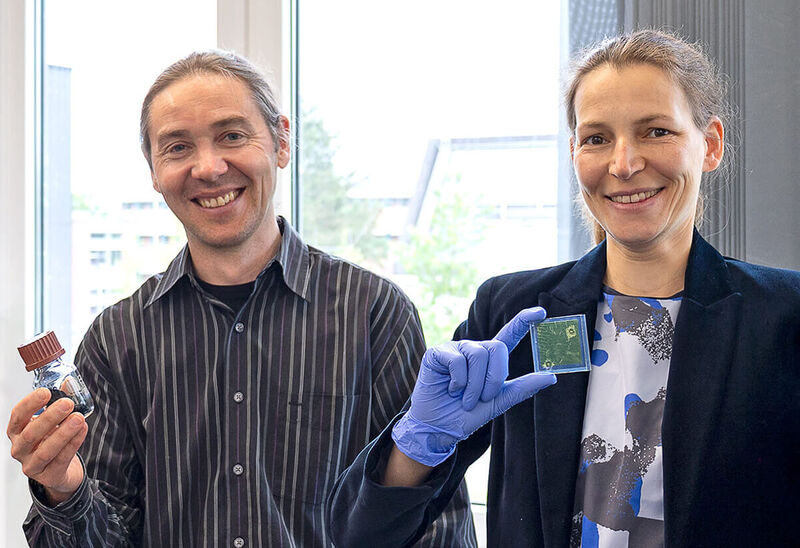
Prof. Mark Elbing and Prof. Nadine Buczek are exploring the future of energy production.
The Grid: Distributing and Storing
Renewable Energy
Smart Energy from A to B
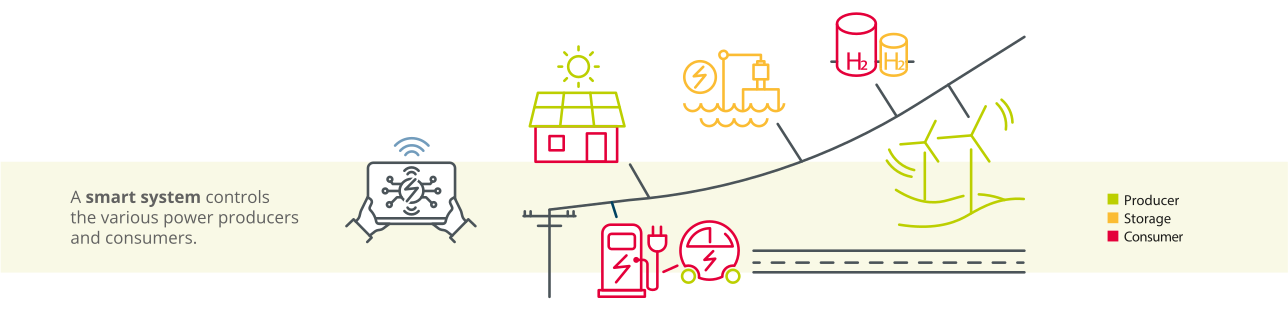
Once the (renewable) electricity has been generated, it needs to be transported to consumers. Ideally, this would involve an intelligent energy system comprised of producers, consumers, storage facilities, and an interconnected grid infrastructure, all perfectly coordinated. The ultimate goal: a 100% share of renewable energy without bottlenecks or grid overloads. Professor Christian Töbermann is working on developing such smart systems.
His focus is on the grids. Energy grids are especially important because self-sufficiency would be extremely uneconomical for individual households
, explains Töbermann. Even at district level an autonomous approach is rarely effective.
This is due to a mismatch between production and consumption times. For example, if a single-family home’s photovoltaic system generates electricity in the afternoon when the family isn’t home, this only makes sense in a self-sufficient system until the storage system is full. Once storage capacity is reached, the system would have to shut down. Building a large enough storage to avoid curtailing altogether wouldn’t be cost-effective either.
If, however, we move away from self-sufficiency toward an intelligent energy system, the surplus energy generated can be directed to other consumers whose demand exceeds their own production in the afternoon. If we continue with the current national planning for photovoltaics and wind power without expanding the grid, a large share of these systems would have to be curtailed in a relatively short time.
, Töbermann notes. But expanding the grid to the point where no curtailment is needed would neither be economically or politically feasible. What’s required is a balanced approach between the expansion of generation, storage, and grid infrastructure, along with intelligent distribution and usage.
Necessary grid expansion also involves varying timelines depending on the voltage level of the grid. While low-voltage grid upgrades can be completed within months to about two years, higher voltage grid expansions require significantly more time.
This makes it all the more important to use the grid efficiently using modern IT systems. Currently, grid operations are managed to present real-time conditions in control rooms for human decision-makers. Especially in the low-voltage grids, where increasing numbers of electric vehicles and heat pumps will be connected in the future, capturing many small-scale data points will be essential. As system complexity continues to grow, automated decision-making becomes both necessary and practical
, says Töbermann.
The grid planning expert also finds the cross-sectoral view of energy grids particularly intriguing. In addition to the electrical grid, this includes the hydrogen grid and the points where the two intersect. One of the aims of the large-scale joint research project Norddeutsches Reallabor, in which Töbermann is also involved, is to develop effective solutions for such cross-sector systems and to determine which grid needs to be expanded and to what extent. This approach will allow grids to complement one another, reducing the need for every grid to be expanded to its full capacity.
Electromobility:
Charging and Storage in one Place
The Research center for Electromobility, Power Electronics, and Decentralized Energy Supply (EMLE) at TH Lübeck focuses in particular on how to integrate a charging park for electric cars into the grid as intelligently as possible. EVs are significant consumers of energy that are intermittently connected to the grid. “Electromobility is not just a question of energy generation and distribution, but above all about storage
, says Clemens Kerssen, EMLE’S spokesperson.
This issue is particularly evident in larger charging parks, for example at rest stops and service stations. When many cars charge simultaneously in a single park, it leads to power peaks on the grid because the charging stations don’t communicate with each other
, Kerssen explains. Researchers at EMLE have addressed this challenge and developed a modular, highly scalable charging park system. While ultra-fast charging is critical at highway rest stops, company charging parks might prioritize slower charging, as employees typically leave their cars idle throughout the workday.
The EMLE charging system supports both scenarios and everything in between. The charging stations communicate with one another, and a connected high-performance storage unit absorbs load spikes. This also enables ultra-fast charging. Kerssen illustrates this system in a video demonstration.
On a related note, user-centric design is vital. Ultimately, the system must integrate a transparent and flexible payment solution for consumers. With so many variables, who or what coordinates the entire operation? Artificial intelligence is indispensable here
, emphasizes Kerssen.
Hydrogen:
A new Hope for Agriculture
Agriculture is currently highly dependent on fossil resources
, says Maximilian Schüler, Professor of Environmental Sciences at TH Lübeck. Many agricultural machines are too large and heavy for battery-powered operation. However, hydrogen technology offers enormous potential to make the sector more sustainable and reduce dependence on fossil fuels. Schüler also believes that agriculture is ideally positioned to utilize renewable energy based on existing technologies.
A key challenge in agriculture is the high energy demand during harvest season, which often spans only a few days per farm and about a month nationwide. During this period, an enormous amount of energy is needed, while consumption over the rest of the year is much lower. Hydrogen storage could play a decisive role in addressing this issue. Renewable energy generated from wind and solar power throughout the year could be stored temporarily in hydrogen storage facilities and used specifically at harvest time to meet the heightened demand.
The amount of fossil energy required to produce food could be significantly reduced this way
, Schüler explains. At the same time, agriculture would become less vulnerable to fluctuating prices of renewable energy sources and could establish more stable and sustainable production conditions in the long term.

Hydrogen offers a sustainable and flexible way to store renewable energy.
Sauerstoff = Oxygen
Wasserstoff = Hydrogen
TH Lübeck: Network Hub in the Region
TH Lübeck serves as a key hub for research and knowledge transfer in the field of renewable energies. The university actively promotes the exchange between academia, industry, and municipalities, particularly within the Hansebelt region, which serves as a model region for the energy, heating and mobility transition.
One example of this collaboration is the Energie / Smart City focus area within the Hanseinnovation Matrix project. Here digital Smart City concepts are combined with the challenges of the energy transition. The region provides a strong foundation for developing innovative solutions that combine renewable energy, mobility, and infrastructure. A key issue is the successful implementation of intelligent systems in a Smart City, with a particular focus on integrating renewable energies into existing infrastructures.
As part of CONBAU Nord, TH Lübeck - together with the Arbeitsgemeinschaft für zeitgemäßes Bauen (ARGE), IB.SH and the NordBau Trade Fair - is also driving forward the heat transition in residential construction. As part of the Baukongress, it brings together experts from across sectors to discuss practice-oriented solutions for the building and energy industries, viewing complex topics from multiple perspectives. The heating transition is both local and personal, yet it is closely interlinked with the transformation of the entire energy infrastructure. Its successful implementation requires coordinated initiatives, informed decisions, and bold action from all stakeholders—from building owners and planners to administrators, builders, and energy providers
, explains Professor Sebastian Fiedler, the project’s initiator.
As part of the joint research project Norddeutsches Reallabor (NRL), TH Lübeck is testing ways to achieve climate neutrality by transforming energy-intensive sectors, particularly in industry and mobility. More than 50 partners from business, science, and politics are working together to develop sustainable innovations and strengthen Northern Germany as an industrial hub. By leveraging hydrogen technology and waste heat recovery, the NRL aims to reduce CO₂ emissions by 75% by 2035 and serve as a model for sector coupling in Germany and Europe.
The state of Schleswig-Holstein is likewise committed to hydrogen technology: It aims to play a leading role in the hydrogen economy and promotes the creation of a regional network. TH Lübeck is part of this hydrogen research community, known as hy.sh. This involvement extends to education: the university has acquired a dedicated hydrogen system that allows students to gain practical experience in all aspects of hydrogen production and utilization.
The Energy Transition in the Building Sector
The building sector accounts for over 30% of final energy consumption in Germany, making it a critical component of the energy transition. In new construction, there are now many ways to reduce energy consumption right from the design stage. Renewable energy sources, such as rooftop photovoltaic systems (PV) or heat pumps that utilize environmental heat, can also be used. What is the challenge then? Reducing energy consumption in existing buildings is a major challenge. The majority of energy consumption in the building sector today comes from existing buildings in cities, neighborhoods, and standalone properties
, says Dirk Schwede, Professor of Energy and Building Engineering in the Department of Architecture and Civil Engineering at TH Lübeck.
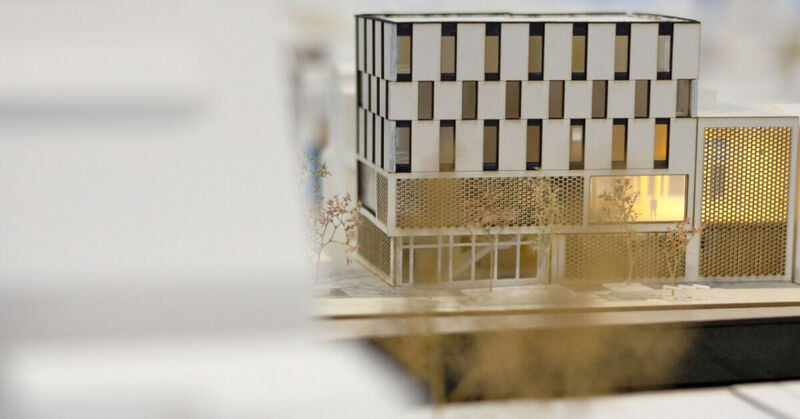
In new buildings, there are many ways to reduce energy consumption right from the design stage. Shown here: A student model of a new building in Lübeck.
What are the solutions? Key to the energy transition are, first, the energy retrofit of buildings to reduce final energy consumption, and second, the climate-neutral supply of energy in the form of electricity and heat from renewable sources. It’s essential to develop balanced and economically viable renovation strategies for both individual buildings and across neighborhoods that can be practically implemented under local technical and socio-economic conditions. The current funding landscape for energy-efficient renovations also plays a critical role
, Schwede notes. Organizational questions are equally important: How do you renovate occupied buildings?
Common technical questions include: Is the heating system suitable for a heat pump?
or Will there be a climate-neutral district heating supply in the future?
Professor Dirk Schwede both researches and teaches these approaches at TH Lübeck. He is an internationally sought-after expert on energy-efficient, climate-friendly, and sustainable buildings. In this role, he connects with networks locally and globally. One local example is the Community of Practice: In the Community of Practice (CoP), we bring together stakeholders working on the energy transition in the building sector from the Lübeck region to discuss relevant topics and foster exchange between different groups
, Schwede explains.
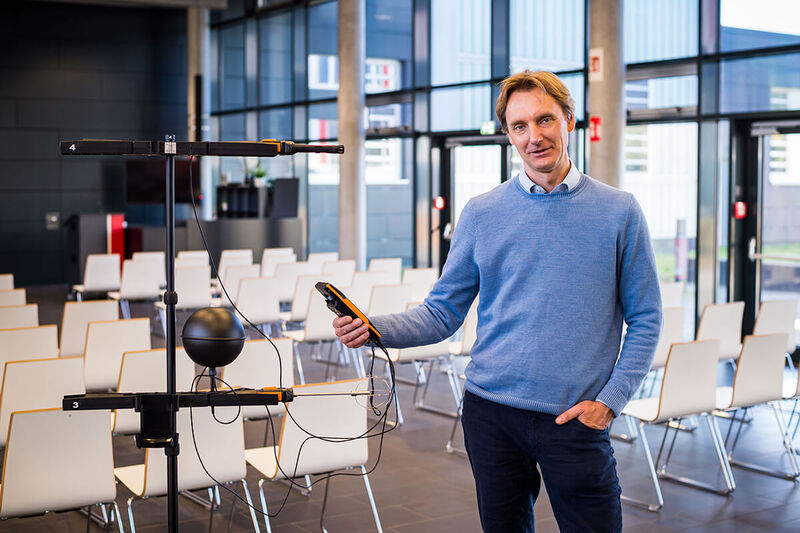
Prof. Dirk Schwede is an internationally sought-after expert on energy-efficient, climate-friendly, and sustainable buildings.
Digital Building Models as Key to Saving Energy
It’s not just new constructions that are relevant: many existing buildings will not undergo any fundamental renovations by the target year for climate neutrality, but must still make their contribution. This contribution will not come in the form of energy-efficient renovation, but rather through building operations optimization and user engagement. To unlock this potential, an interdisciplinary research team at TH Lübeck launched a project called Digital Infrastructure for Sustainable Building Operations (DING) heißt es.
As part of this project, typical existing buildings used for teaching, research, and administration on the TH Lübeck campus are being closely examined. The goal is to collect and share data that enables researchers to study how building usage impacts energy consumption and supply. Based on this data, the team develops further strategies to reduce energy consumption and increase the use of renewable energy. The project involves collaboration between four subject areas from the departments of Architecture and Civil Engineering, Electrical Engineering and Computer Science, and Applied Natural Sciences.
Investments have been made in modern stationary and mobile measurement technologies, including sensors for indoor air, windows, heating, and lighting, as well as meters for heat and electricity consumption. Sensors to monitor building usage and weather conditions have also been implemented. In addition, digital models of the buildings have been created that contain all the information needed for simulations to develop innovative operational strategies. DING allows us to carry out comprehensive research projects focused on optimizing building operations and engaging users while testing innovative approaches and methods in a real-world laboratory
, explains project leader Professor Sebastian Fiedler, highlighting the value and sustainability of the project.
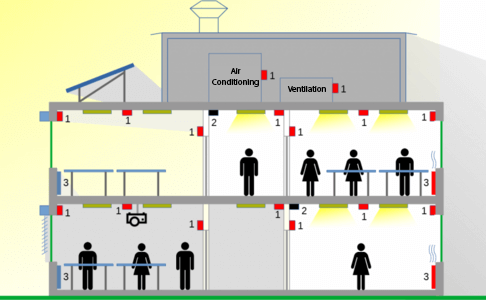
Sensors on doors and windows collect data on temperature and building use.

Simulating for a More Efficient Energy Transition
Animation of building ventilation. Source: Christian Blatt
Simulating for a More Efficient Energy Transition
The data collected in the DING project can be used to feed building simulations. Often, it’s not immediately clear which energy measure is most promising for a given building, because building design and building systems must work in harmony.
Christian Blatt, Professor of Building Simulation and Optimization, explains: The beauty of a building simulation is that you can visualize what you are doing. You can compare many different scenarios and identify the best solution.
For instance, simulations can display different thermal layers inside the building, indicate the temperature at varying heights, and show how air circulates throughout the building. This makes it possible to determine the ideal number, height, and size of windows, the placement of ventilation systems, and which technical systems would be most suitable.
While new construction typically begins with well-defined parameters, work on existing buildings begins with gathering the necessary information: Are the original blueprints still accurate? How thick are the walls? Which materials were used? What is typical for buildings of that era and region? In some cases, measurements have to be taken on site. The goal is a detailed room database, that serves as basis for the simulation. With that data, you can reconstruct the building from the ground up
, says Blatt. Then you can begin to simulate and optimize systems, like heating.
A frequent concern is to avoid overheating and improve summer thermal protection. Large glass surfaces are particularly tricky. You have to consider how far you can go with passive ventilation concepts and shading, or whether you need air conditioning - otherwise you can quickly end up with 50°C (122°F) indoors
, Blatt notes.
Particularly Suited for the Exceptional
According to Blatt, simulations are currently especially worthwhile for unique, high-profile buildings, such as museums. Another compelling
application are complex factories, where internal conditions like machine waste heat and similar influences must be considered in addition to external factors like solar radiation.
Blatt is also keenly interested in historic buildings. Owners of such properties often ask valid questions, such as whether a heat pump would be economically viable and, if so, how it should be configured. Other common inquiries involve photovoltaic systems or solar thermal energy, particularly in the context of heritage conservation regulations. The more unique a building is, the more prone to error the standard approach, which relies on predefined calculation tables, becomes. I’m convinced that in 10 years, simulations will be the norm for many buildings, at least in higher-end segments
, says Blatt. One day, I’d also like to launch a research project focused on standard buildings, where results can be broadly applied from one structure to another. I believe there’s still a lot of potential, as building simulation can prevent costly mistakes and significantly reduce costs.
Proactive Heating Solutions
Once the decision for a heating system has been made, Ulf Lezius comes into play. Heat pumps, for example, operate most efficiently when they run steadily over extended periods, rather than being forced to deliver large bursts of heat during sudden cold spells. That’s why Lezius is developing a system that integrates weather forecasts, heating systems, and digital building models, such as those produced by the DING project. This system enables automated, predictive heating while optimizing it for the specific usage of each room. If a movie theater is primarily used in the evening, an algorithm calculates when the heat pump should start before a temperature drop, and at what intensity it should run, to efficiently achieve the desired temperature on time. To make this work, the system collects real-time data every 15 minutes from the building, the weather forecasts, the room scheduling plans, and actual room occupancy. A simulation then determines which heating strategy is the most effective.
These optimizations are especially important for large heat pumps in district heating networks. In the future, the system could also incorporate data from electricity production. If there is an abundance of low-cost, renewable wind energy on the grid, for instance, this could significantly influence the simulation results and heating strategy. Lezius is confident: We need smart strategies for forecasting, regulating, and managing energy systems.
Energy-Efficient, Sustainable Construction Abroad
The building sector is a major driver of sustainable transformation not only in Germany but worldwide. Globally, it contributes substantially to greenhouse gas emissions, resource consumption in the form of building materials, land use, and waste generation. At the same time, the built environment provides the framework for comfortable, high-quality living.
Professor Dirk Schwede, who has previously worked as a researcher and consulting engineer in Australia, Asia, and the Middle East, is involved in various projects focusing on sustainable construction abroad. In the BMBF-funded project Climate-Adapted Material Research for the Socioeconomic Context in Vietnam (CAMaRSEC) a large consortium of scientists from Germany and Vietnam investigated the use of sustainable building materials for tropical climates in Vietnam. In another BMBF-funded project, Resource-Efficient Construction with Sustainable Building Materials (ReBuMat) interdisciplinary networking among researchers and practitioners to promote the use of sustainable materials.
Professor Schwede’s work in the sustainable development and transformation of the construction and building sector in other countries is part of technical development cooperation projects. Key topics include energy-efficient heating, cooling, and ventilation of buildings, resource-efficient construction, and life cycle assessment of buildings. These projects also focus on developing evaluation and financing instruments for sustainable buildings and neighborhoods, tailored to countries at different stages of development in their construction industries.
Skilled Professionals Are Key
I am frequently approached by companies asking if I can refer someone with a strong technical background
, says Christian Blatt. The demand for skilled professionals is everywhere, whether in sustainable building technology, control engineering, power systems, or microprocessor technology. Fortunately, TH Lübeck offers a range of degree programs that prepare people for the challenges of the energy transition, and we always welcome applications
, says Jochen Abke, Vice President for Studies and Digitalization at TH Lübeck. Prospective students need not fear mathematics. In conversations, we often hear concerns that one’s math skills might not be sufficient for university. We offer preparatory courses to prepare all students for their studies. Our instructors are also happy to provide personal advice and hands-on support during the program.

Around 5,000 future professionals and leaders are currently studying at TH Lübeck, including many who will help shape the energy transformation.
A simple LED bulb today consumes only about a tenth of the energy a traditional incandescent bulb once required. This advancement in energy technology wasn’t immediately embraced by everyone. What helped the industry and ultimately led to the breakthrough of LED technology was a clear political framework
, says Dr. Norbert Reintjes, Professor of Industrial Ecology in the Department of Applied Natural Sciences at TH Lübeck. Prior to his academic career, he led environmental product innovation at a consultancy, contributing to the development of environmental labels, the EU’s Ecodesign Directive, and the Energy Labeling Regulation.
Household lighting is just one example of how, since the 2000s, regulatory tools in EU product policy have played a critical role in improving the energy efficiency of products used in households, buildings, and industry. In light of the massive climate crisis, however, a rapid and complete transition to renewable energy sources is essential
, Reintjes emphasizes. Legal regulations and incentive systems are integral to this consistency approach, as they establish the conditions that significantly influence the pace of implementation.
Far more challenging for political, economic, and societal systems is the third approach: sufficiency. Sufficiency is often associated with painful deprivation or technological regression, but at it’s core it simply means ‚enough or adequate‘
, explains Reintjes. Reduced consumption can, in fact, be positively perceived and contribute to a higher quality of life.
In the broader picture, efficiency and sufficiency reduce overall energy demand, which then must be met by renewable energy sources. The developments of recent decades show that while efforts to enhance efficiency and transition to renewables are essential, sufficiency plays a central role in tackling the climate crisis
, Reintjes concludes.
TH Lübeck: Practical Solutions for
Climate-Neutral Energy Supply
Our society will continue to consume electricity, which is why faculty and students at TH Lübeck are exploring smart ways to generate it. Whether through lightweight solutions for maritime applications, solar algae, or thermoelectric generators, innovative approaches are at the forefront. The energy produced must then be distributed intelligently and efficiently. Researchers at TH Lübeck are working on that as well, developing technical systems to optimize grid utilization,whether at the level of large-scale grid planning or improving decentralized networks, such as those for EV charging parks.
We also focus on improving the thermal energy efficiency of buildings. This involves taking measurements, running simulations, and analyzing materials and their production under different conditions. Most importantly, we are training the skilled professionals who will lead the energy transition in every sector. It’s no exaggeration to say that TH Lübeck excels at optimizing both efficiency and consistency.
What we can’t solve with technology alone is sufficiency—learning to live with enough. That responsibility lies with all of us as a society.
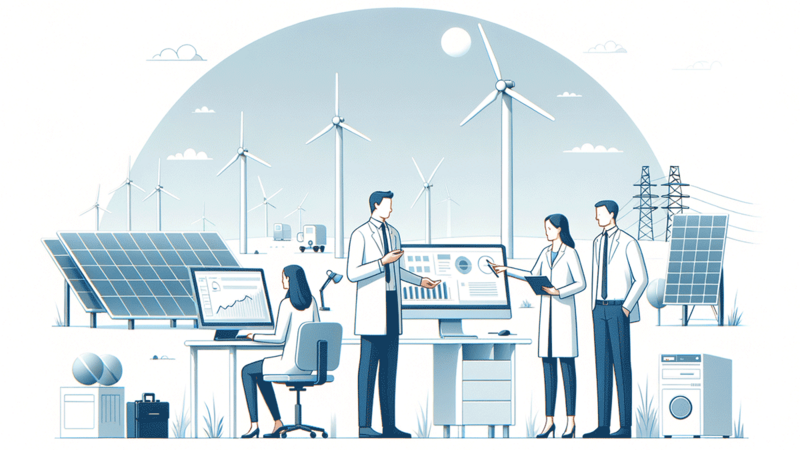
At TH Lübeck, applied research and education are advancing the energy transition.
Contact
| Prof. Dr. rer. nat.
Dipl.-Phys.
Markus Riotte | |
| Phone: | +49 451 300 5373 |
| E-Mail: | markus.riotte@th-luebeck.de |
| Room: | G.2 17-1.11 |
| Prof. Dr. rer. nat.
Nadine Buczek | |
| Phone: | +49 451 300 5167 |
| Fax: | +49 451 300 5512 |
| E-Mail: | nadine.buczek@th-luebeck.de |
| Room: | D.2 20-0.06 |
| Prof. Dr. rer. nat.
Mark Elbing | |
| Phone: | +49 451 300 5010 |
| E-Mail: | mark.elbing@th-luebeck.de |
| Room: | G.1 13-0.10 |
| Prof. Dr.-Ing.
J.-Christian Töbermann | |
| Phone: | +49 451 300 5184 |
| E-Mail: | christian.toebermann@th-luebeck.de |
| Room: | F.9 21-0.07 |
| Prof. Dr. rer. agr.
Maximilian Schüler | |
| Phone: | +49 451 300 5554 |
| E-Mail: | maximilian.schueler@th-luebeck.de |
| Room: | G.1 13-0.26 |
| Prof. Dipl.-Ing.
Sebastian Fiedler | |
| Phone: | +49 451 300 5499 |
| E-Mail: | sebastian.fiedler@th-luebeck.de |
| Room: | E.1 14-0.19 |
| Prof. Dr.
Dirk Schwede PhD | |
| Phone: | +49 451 300 5367 |
| E-Mail: | dirk.schwede@th-luebeck.de |
| Room: | E.1 14-1.20 |
| Prof.
Christian Blatt M.Sc. | |
| Phone: | +49 451 300 5789 |
| Fax: | +49 451 300 5079 |
| E-Mail: | christian.blatt@th-luebeck.de |
| Room: | E.1 14-1.23 |
| Prof. Dr. rer. nat.
Dipl.-Biol.
Norbert Reintjes | |
| Phone: | +49 451 300 5241 |
| Fax: | +49 451 300 5512 |
| E-Mail: | norbert.reintjes@th-luebeck.de |
| Room: | G.1 13-0.24 |
| Clemens Kerssen
M.Sc.
| |
| Phone: | +49 451 300 5428 |
| E-Mail: | clemens.kerssen@th-luebeck.de |
| Room: | F.5 4-0.19 |
| Prof. Dr.-Ing.
Ulf Lezius | |
| Phone: | +49 451 300 5392 |
| E-Mail: | ulf.lezius@th-luebeck.de |
| Room: | G.2 17-2.07 |
Specialist Groups
Applied Photonics
Photonics is the key technology of the 21st century, driving innovation in telecommunications, medical technology, the automotive industry, and quantum technologies. From laser engineering to optical sensors to photonic chips, this cutting-edge field offers exceptional career opportunities. As a photonics specialist, you help shape the digital transformation and benefit from excellent job prospects in the high-tech sector.
Intelligent Energy Use
The Center of Excellence for Intelligent Energy Systems (WiE) develops innovative solutions for the energy transition and smart energy systems. Key research areas include AI-based energy optimization, smart grids, and a sustainable energy sector. Through interdisciplinary collaboration, the center is pioneering technologies that enhance energy efficiency and enable CO₂ neutrality. As a center of excellence for modern energy systems - we are actively shaping a climate-neutral future.
Materials for Storage and Renewable Energy Systems
Revolutionary materials research is key to a successful energy transition. Our research group develops innovative materials with photoelectric, thermoelectric, and electrochemical properties for batteries, solar cells, and fuel cells. From perovskite solar cells and solid-state batteries to hydrogen storage systems - we are creating the next generation of energy storage technologies. Cutting-edge research for sustainable energy solutions.
Sustainable Design, Construction, and Operation
Green building and sustainable construction are the answer to climate change in the building sector. Our approach combines environmental responsibility with economic viability and social equity. From cradle-to-cradle concepts to energy-plus buildings and smart building management - we design climate-neutral construction solutions. For a livable future within planetary boundaries and sustainable urban development.
Photovoltaics
Since 1976, TH Lübeck has been a pioneer in solar energy research in Germany. Our historic solar house, built in 1982, marked the beginning of our long-standing tradition in photovoltaic research. Today, we develop high-efficiency solar cells, innovative module technologies, and intelligent PV systems. From perovskite tandem cells and floating solar arrays to building-integrated photovoltaics (BIPV) - we are shaping the solar energy future. World-class solar research, made in Lübeck.
Environmental and Climate Protection
Climate protection needs concrete solutions. Our research group focuses on practical strategies for effective environmental and climate protection. Key areas include CO₂ reduction, circular economy, biodiversity conservation, and sustainable resource use. Through interdisciplinary research and technology transfer, we create innovative responses to the climate crisis. As Center of Excellence for Applied Climate Protection - we make a vital contribution to sustainable transformation.
Science Center for eMobility, Power Electronics and Decentralized Energy Supply (EMLE)
The Electromobility and Power Electronics group (EMLE) at Technische Hochschule Lübeck was originally founded as the Renewable Energies and eMobility research group (EEeM) by Prof. Dr. Tiedemann in July 2012 to address a wide range of unresolved technical and legal questions surrounding the energy and mobility transition.
Services for Small and Medium-Sized Enterprises (SMEs)
Sustainability Check by the Intelligent Business Processes Group

Sustainable development means companies focus on more than just economic success. They also consider long-term ecological, social, and entrepreneurial issues. This approach is critical to the competitiveness of SMEs, as customers, investors, and regulators place greater emphasis on sustainable business practices.
Energy Toolkit from CoSA - Center of Excellence
Many small- and medium-sized enterprises (SMEs) currently face major challenges identifying and implementing energy-saving measures. To help SMEs identify energy-saving opportunities and implement effective measures, researchers at the CoSA Center of Excellence at TH Lübeck have developed an “Energy Toolkit.” It includes various sensors that detect consumption patterns and highlight potential savings.
JuniorCampus
ASK, EXPLORE, DISCOVER!

The JuniorCampus at TH Lübeck is a space for preschoolers to ask questions, explore freely, and find answers on their own. Here, learning becomes an adventure - innovative, playful, and with plenty of room for discovery!
Hands-on experimentation helps children build knowledge while also strengthening social skills, creativity, and empathy These skills are essential for children's development and form the basis for holistic learning.
What can you expect? Fascinating questions like:
- Why does toast pop up at exactly the right moment?
- How does our heart beat—without a motor?
- Do apples really always fall down?
- And what does a cabbage have to do with mathematics?
Immerse yourself into the exciting world of STEM subjects (Science, Technology, Engineering, and Mathematics). No prior knowledge is required—just curiosity and an open mind. A passion for STEM is contagious and turns learning into a joyful, rewarding experience.
Join us and help spark a lifelong love of discovery!
Visit the JuniorCampus at TH Lübeck >>
Podcast episodes (german)
Explore Renewable Energy in These Degree Programs
Applied Chemistry
B.Sc.
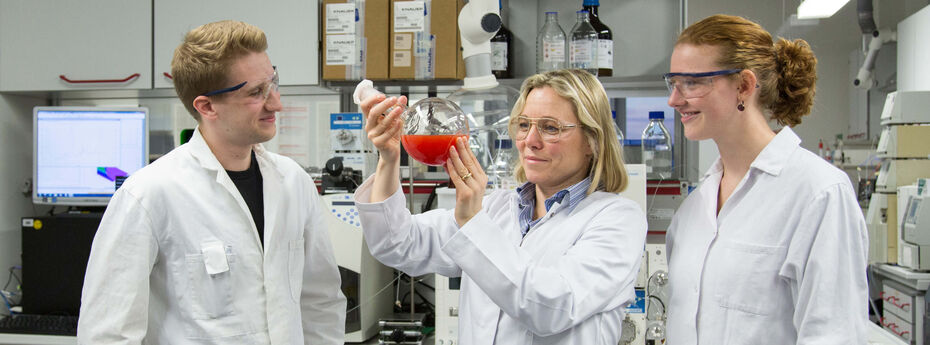
The Applied Chemistry bachelor's program provides a practice-oriented education covering all core areas of modern chemistry. Students gain in-depth knowledge in organic, inorganic, and physical chemistry, while also engaging with cutting-edge fields such as materials science and biotechnology. Graduates can expect excellent career opportunities in industry, research, and development.
Civil Engineering
B.Eng.
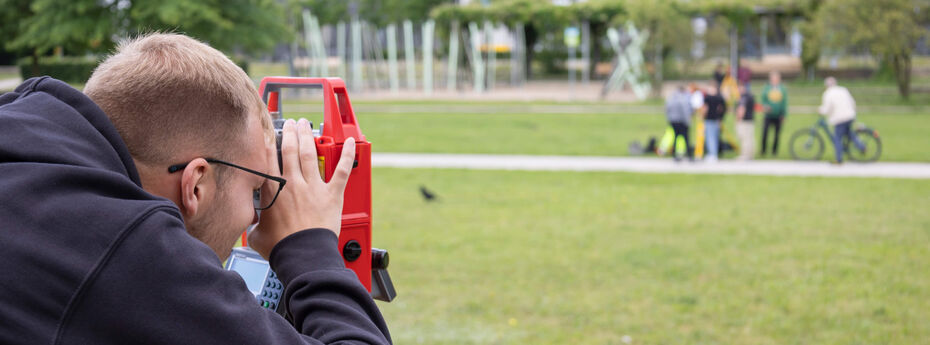
This seven-semester bachelor’s program in Civil Engineering combines the fundamentals of structural engineering with sustainable planning methods and digital technologies such as Building Information Modeling (BIM). The curriculum includes engineering mathematics, interdisciplinary projects with architecture students, as well as a strong focus on statics, structural design, and environmental engineering. The program also offers the option to qualify as an energy consultant. Graduates enjoy excellent career prospects in both the construction industry and the public sector.
Electrical Engineering
B.Sc.
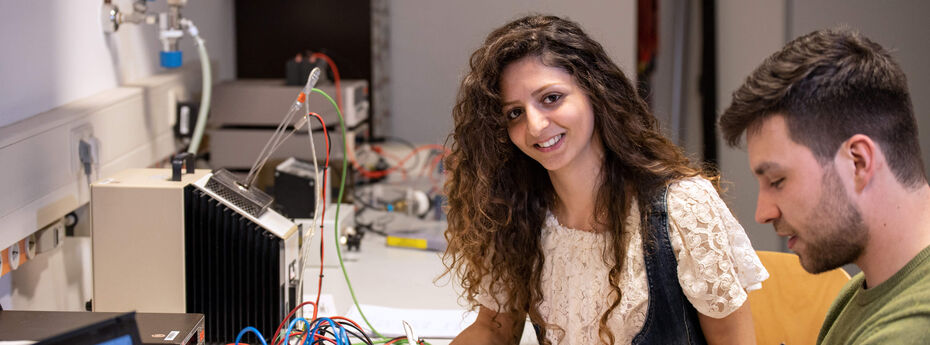
Electrical engineering is one of the most in-demand STEM fields of the future. From e-mobility and smart homes to renewable energy systems, electrical engineers are key drivers of the digital transformation. This bachelor’s program provides comprehensive skills in automation technology, microelectronics, and sustainable energy systems. Graduates are well prepared for a broad range of careers across all sectors.
Applied Information Technology
M.Sc.
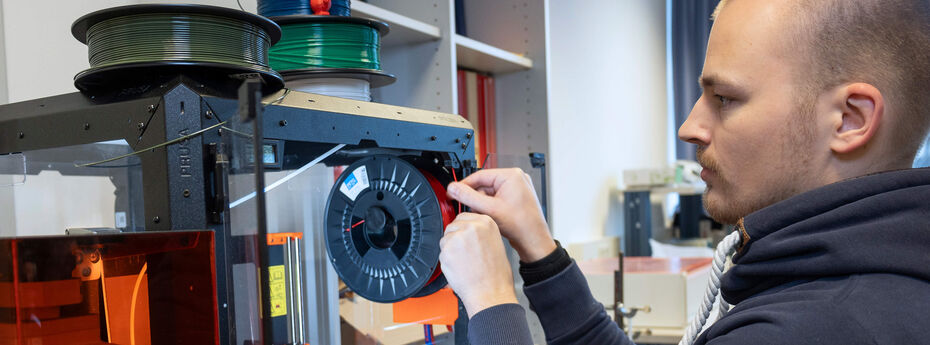
This master’s program is designed for graduates of electrical engineering who wish to specialize in emerging fields such as cyber-physical systems, the Internet of Things (IoT), and Industry 4.0. Core topics include artificial intelligence, machine learning, and networked systems. The practice-oriented curriculum provides excellent preparation for leadership roles in the digitalized industrial sector. Graduates benefit from outstanding career prospects in innovation and development.
Applied Physics
M.Sc.
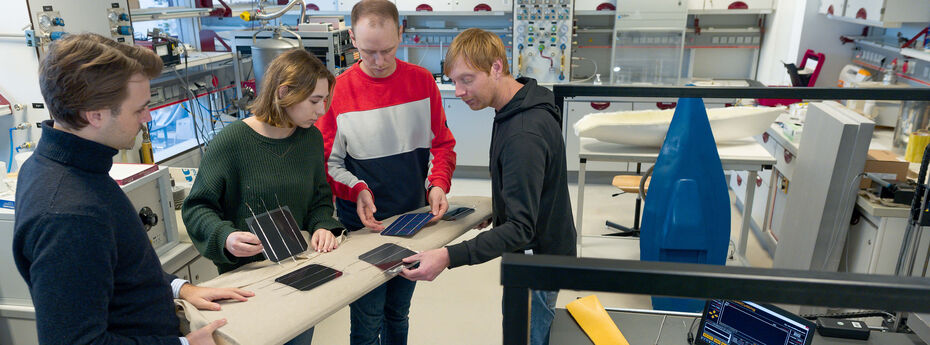
This master's program combines theoretical physics with application-oriented research in emerging technologies. The program focuses on quantum technology, nanotechnology, semiconductor physics, solar energy, and AI applications. Graduates are trained to become sought-after innovation experts in research and development in high-tech companies and scientific institutions. The program guarantees excellent career prospects across a wide range of advanced fields.
Electrical Engineering – Energy Systems and Automation
B.Sc.
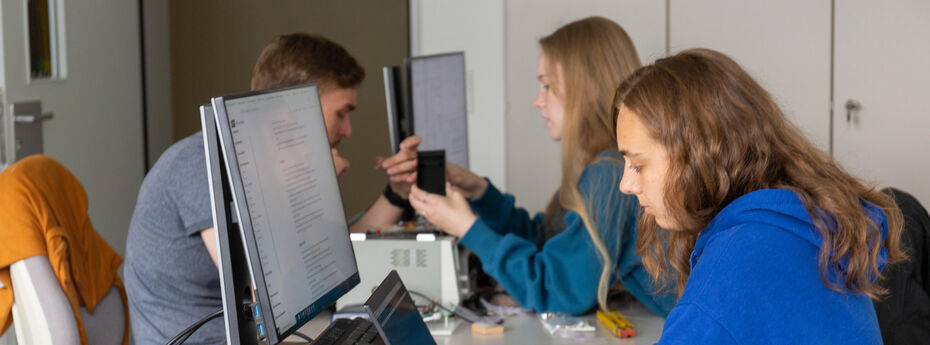
Digitalization, e-mobility, and the energy transition all rely on electrical engineering. This future-oriented bachelor’s program focuses on intelligent energy systems, automation technology, and sustainable power supply. From smart grids to robotics, graduates are equipped to help shape the climate-neutral industries of tomorrow. Excellent career opportunities await in the rapidly growing green tech sector.
Sustainable Chemistry
M.Sc.
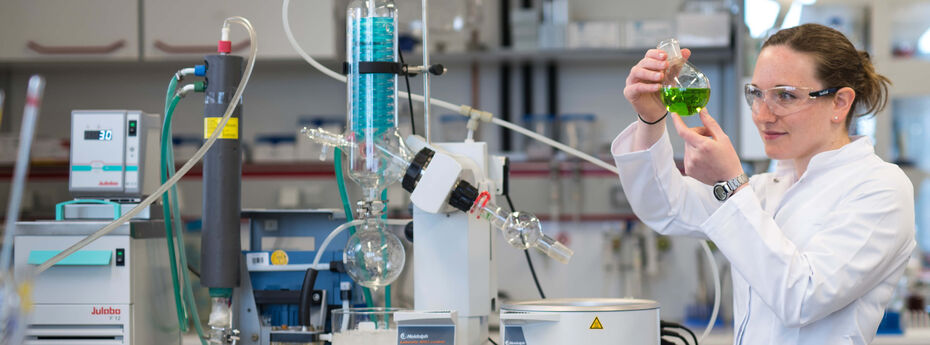
Green chemistry is the chemistry of the future: resource-efficient, environmentally responsible, and innovation-driven. This master's program prepares students to become experts in sustainable synthesis methods, the bioeconomy, and green materials. With specialized knowledge in biotechnology, catalysis, and circular economy systems, graduates are well equipped to contribute to the transformation of the chemical industry. Outstanding career prospects in the field of sustainable chemistry are guaranteed.
Sustainable Building Technology
B.Eng.
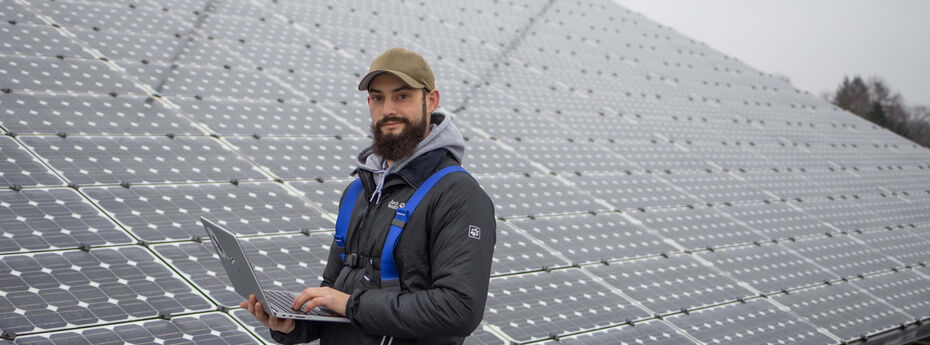
Climate engineering for the future: This innovative bachelor’s program trains engineers in energy-efficient and climate-neutral building technologies. Key areas of focus include smart building systems, renewable energy technologies, and sustainable construction. The program also includes qualification as a certified energy consultant. As a specialist in green building technology, graduates actively contribute to the decarbonization of the construction industry. Excellent career opportunities are assured.
Engineering Physics
B.Sc.
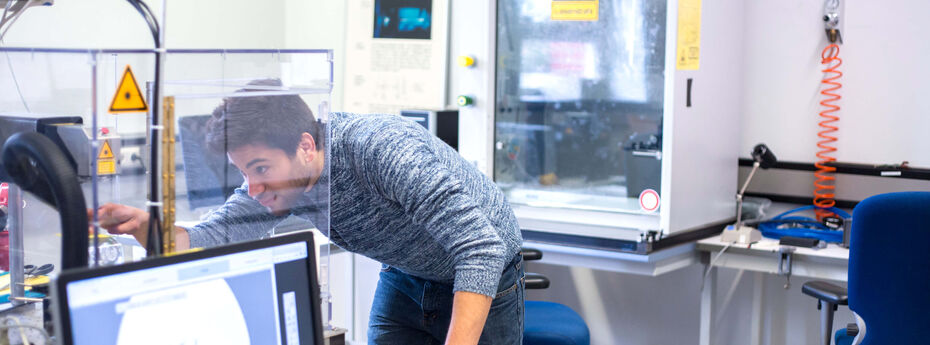
This interdisciplinary bachelor’s program combines fundamental physics with industrial applications and modern technologies. Topics range from laser and measurement technology to materials physics and quantum technology. Graduates are trained as versatile problem-solvers with broad scientific and technical expertise, positioning them ideally for careers in research and development, high-tech industries, and innovation management.
Renewable Energy (Online)
B.Eng.
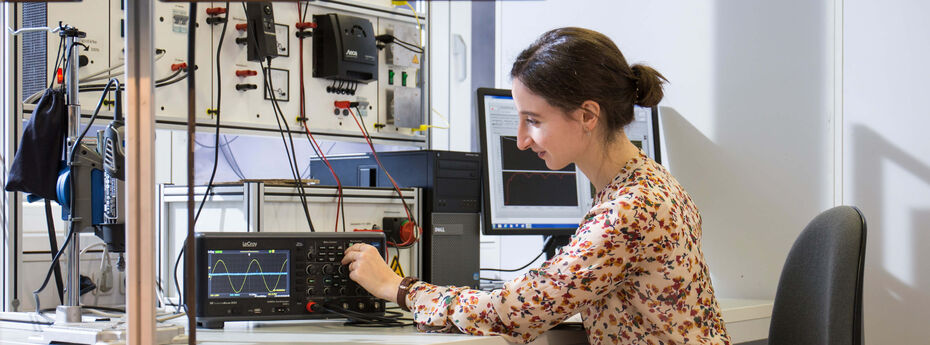
The energy transition depends on qualified specialists: By 2030, 80% of electricity is expected to come from renewable sources. This online program provides comprehensive expertise in photovoltaics, wind power, energy storage, and smart grid technologies. The flexible online format allows you to study part-time while maintaining professional commitments. As a renewable energy engineer, you will play an active role in shaping a sustainable energy future. Excellent career prospects in the green tech sector await you.
Environmental Engineering and Management
B.Sc.
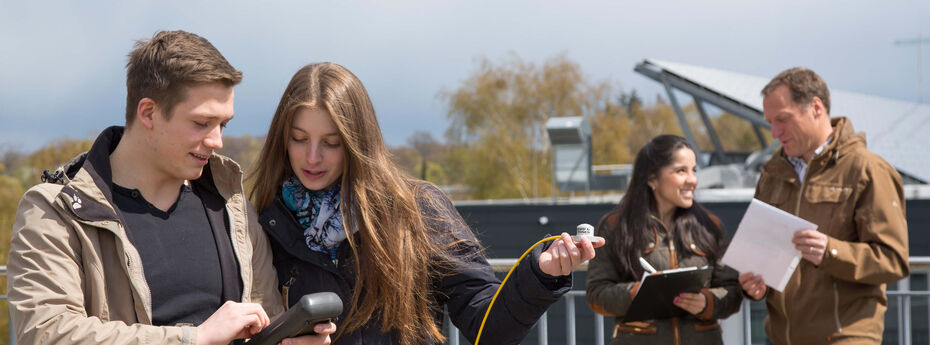
Sustainable development requires interdisciplinary thinking. This bachelor's program combines engineering with environmental management and sustainability. Key areas of study include circular economy, environmental technology, resource management, and corporate sustainability. Graduates are trained to become sought-after change agents driving the green transformation across industry, government, and consulting. Excellent career prospects await in the growing green economy.
Environmental Management
M.Sc.
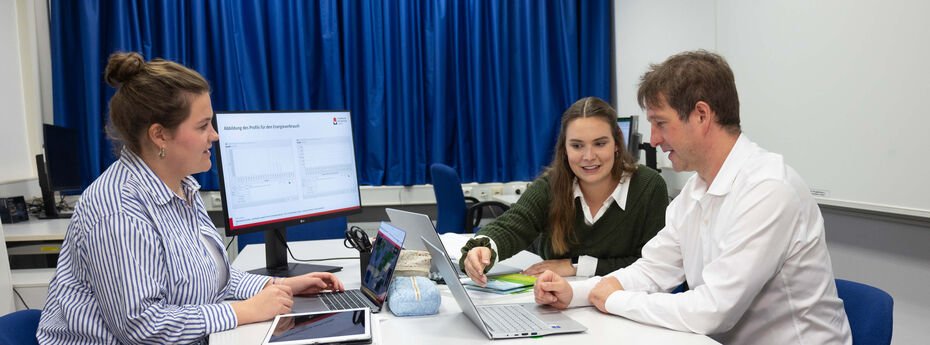
Sustainability leadership for the future: This master’s program prepares students for leadership roles in environmental and sustainability management. Core topics include ESG management, climate protection, circular economy, and sustainable corporate governance. With interdisciplinary expertise spanning ecology, economics, and social responsibility, graduates are ideally positioned to become highly sought-after sustainability managers. Excellent career prospects in the green economy are assured.