Environmental Engineering and Management, B.Sc.
Incoming exchange students are welcome also without speaking German. Besides individual courses in this study programme several courses related to environmental issues are taught in parallel programmes. For more information contact our International Office.
Comprehensive environmental protection requires the consideration of technical, economic, ecological, and social levels and can only be achieved through interdisciplinary collaboration.
The broadly designed environmental-related bachelor’s degree in Environmental Engineering and Management covers not only technical subjects and subjects related to natural sciences, but also modules related to relevant framework conditions and management. It qualifies graduates to work in variety of organizations and companies. Examples include government agencies with environmental responsibilities, environmental consulting firms, and non-governmental organizations. In the business sector, graduates are prepared to oversee environmental management systems, take responsibility for corporate environmental protection, or optimize the environmental performance of products or processes.
Successful completion of the program qualifies graduates for further master’s degree programs, such as the master’s in Environmental Management at TH Lübeck.
“Students enrolling for the Winter Semester 2023/2024 or later will be subject to modified study and examination regulations. The changes include the elimination of the pre-study internship, a further strengthening of the environmental core subjects and more flexibility in the elective modules.”
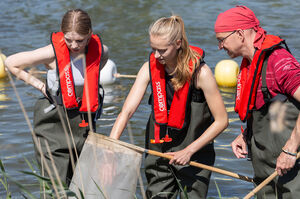
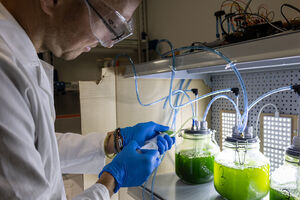
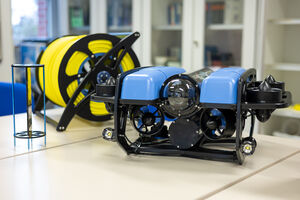
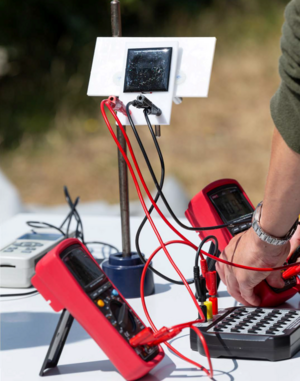
In Brief – Environmental Engineering and Management
Environmental Engineering and Management is a broad-based Bachelor’s degree program in the Department of Applied Natural Sciences at TH Lübeck that combines engineering and natural sciences modules with management topics and relevant regulatory frameworks. The program provides a comprehensive overview of technical, ecological, economic, and societal connections, equipping students to think and work interdisciplinarily at the intersection of environmental technology and environmental management. It prepares graduates for roles in public authorities, environmental consultancies, NGOs, and industry.
Admission requires the general higher education entrance qualification (Abitur) or the entrance qualification for universities of applied sciences (Fachhochschulreife, including the practical component); relevant vocational qualifications are also recognized. The degree program is admission-free (open admission), meaning there is no Numerus Clausus (NC / minimum GPA requirement). A pre-study internship is not required. The program begins in the winter semester.
The degree program is interdisciplinary, combining scientific and technical fundamentals (e.g., mathematics, chemistry, physics, biology, and process engineering) with business and management-related topics such as business administration, environmental assessment, and environmental law. Foundational subjects predominate in the early semesters before delving deeper into environmental engineering and environmental management.
Because the program is intentionally broad, the depth of individual modules remains manageable. At the same time, students are required to connect diverse subject areas and apply them in interdisciplinary projects, which calls for an interest in multifaceted systems rather than narrow specialization.
Elective modules allow students to set individual focus areas in fields such as ecology, solar technology, environmental assessment, environmental process engineering, and environmental sciences. In addition, optional courses allow students to pursue personal interests and expand their specific competencies.
A semester abroad is an integral part of the curriculum: the 6th semester features a dedicated mobility window for studying at an international partner university. Stays abroad can also be completed through electives, summer schools, an internship, or the final thesis.
The demand for qualified professionals in sustainability and climate action is steadily increasing; career prospects for graduates are therefore considered excellent. Opportunities can be found in industry (operational environmental protection, optimization of technical processes and products), environmental consultancies, NGOs, engineering consultancies, and across various environmental authorities in the public sector. The renewable energy, waste management, and water management sectors offer particularly broad perspectives. For those wishing to continue studying after the Bachelor’s degree: the consecutive Master’s program in Environmental Management (M.Sc.) at TH Lübeck is structured over three semesters and also paves the way for a doctorate (Ph.D.).
Contact
Head of Program and Academic Counseling
| Prof. Dr. rer. nat.
Dipl.-Biol.
Norbert Reintjes | |
| Telefon: | +49 451 300 5241 |
| Fax: | +49 451 300 5512 |
| E-Mail: | norbert.reintjes@th-luebeck.de |
| Raum: | G.1 13-0.24 |
Academic Counseling, Responsible for Pre-Study and Professional Internship
| Prof. Dr. rer. agr.
Maximilian Schüler | |
| Telefon: | +49 451 300 5554 |
| E-Mail: | maximilian.schueler@th-luebeck.de |
| Raum: | G.1 13-0.26 |
Liaison Professor
| Prof. Dr. rer. nat.
Kai Seger | |
| Telefon: | +49 451 300 5608 |
| E-Mail: | kai.seger@th-luebeck.de |
| Raum: | C.1 11-2.05 |
Admission Office
Do you have questions regarding application or enrolment?
Please contact our Admission Office.
Phone: +49 451 300 5644 (Service Point)
E-mail: studieren(at)th-luebeck.de
Room: 36-0.50