
Open KI IoT SH (IoT-Hub)
Open LoRaWAN KI IoT Plattform Schleswig-Holstein
| Duration: | 01.04.2025 - 31.03.2028 |
| Project Leader: | Prof. Dr.-Ing. Horst Hellbrück |
| Staff: | Finja Wegener, M.Sc. , Tom Kruse M.Sc. |
Background
As the Internet of Things (IoT) continues to develop, the need for powerful and open infrastructures is growing. Schleswig-Holstein already has an extensive LoRaWAN infrastructure that is operated by public and private providers. That infrastructure forms the technological basis for the Open KI IoT SH project - an open platform that combines modern IoT technologies with artificial intelligence (AI). Together with regional partners, the existing infrastructure is being expanded in a targeted manner and utilised for innovative applications.
Objectives
The aim of the Open KI IoT SH project is to set up and operate an open, AI-based IoT platform for Schleswig-Holstein. The platform is based on the existing LoRaWAN infrastructure and is being further developed together with regional partners. It is targeted at research institutions, public authorities, companies and private users and enables the easy integration of proprietary sensors, the utilisation of existing data and the development of innovative AI-based applications. This creates a future-oriented basis for a wide range of digital application scenarios in science, business and public administration.
Innovation
The project creates the conditions for the long-term, sustainable and scalable development of an interoperable system that can be used in both municipal and commercial contexts. In addition, the platform makes the practical benefits of IoT and AI directly tangible through pilot projects and demonstrations. At the end of the project, the platform will be seamlessly transitioned into regular operations, providing a viable, future-oriented solution for numerous everyday and application situations.
Technical Concept
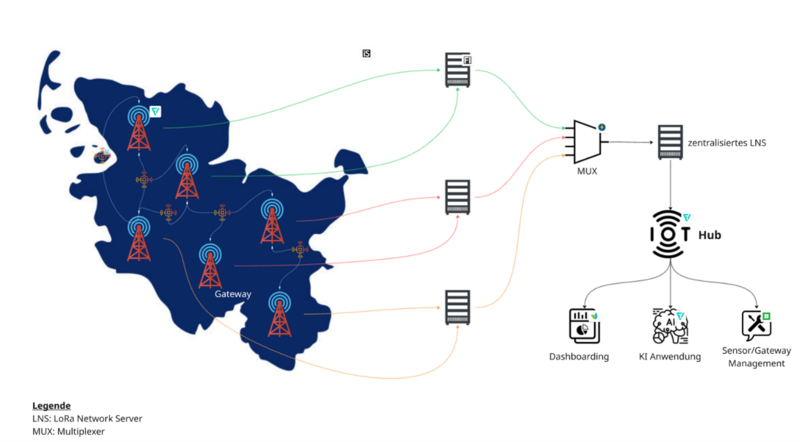
The figure illustrates the conceptual design for the technical implementation in the form of a general data flow. On the left-hand side is the statewide LoRa network, which collects telemetry data from sensors (orange) across the entire area and transmits it via gateways (red/blue) to various LoRa Network Servers (LNS). These LNS are operated by both public institutions and private companies.
Dataport provides connectivity to the different LNS using a multiplexer approach. This creates a central interface between the statewide LoRa network and the emerging IoT hub.
Platform Architecture
Kubernetes was chosen as the foundation for the IoT platform infrastructure. Kubernetes serves as a management system for container‑based applications and enables the operation of a microservice architecture. By running microservices in a distributed and redundant cluster, Kubernetes ensures high availability, flexible scalability, and a robust operating environment. In combination with Terraform, an Infrastructure‑as‑Code tool, the infrastructure can be described declaratively and provisioned automatically. This increases reproducibility and simplifies adjustments: in case of changes or a hardware migration, the infrastructure can be re‑created with minimal effort.
The core architecture of the platform is based on ThingsBoard and ChirpStack. However, results from workshops, surveys, and analyses showed that these existing platforms do not provide a user‑friendly solution without extensive custom development. In particular, ThingsBoard does not meet all identified requirements regarding usability and accessibility.
Therefore, the decision was made to develop a dedicated frontend and implement the integration via a Backend‑for‑Frontend (BFF).A BFF is a modern architectural approach that consolidates the various interfaces of underlying services and provides a unified API for the user interface. This allows additional services, such as AI modules, to be integrated flexibly without requiring the frontend to communicate with multiple interfaces. At the same time, backend services can evolve without necessitating changes in the frontend.
Project Partner

The state of Schleswig-Holstein
Förderkennzeichen: 220 25 003